
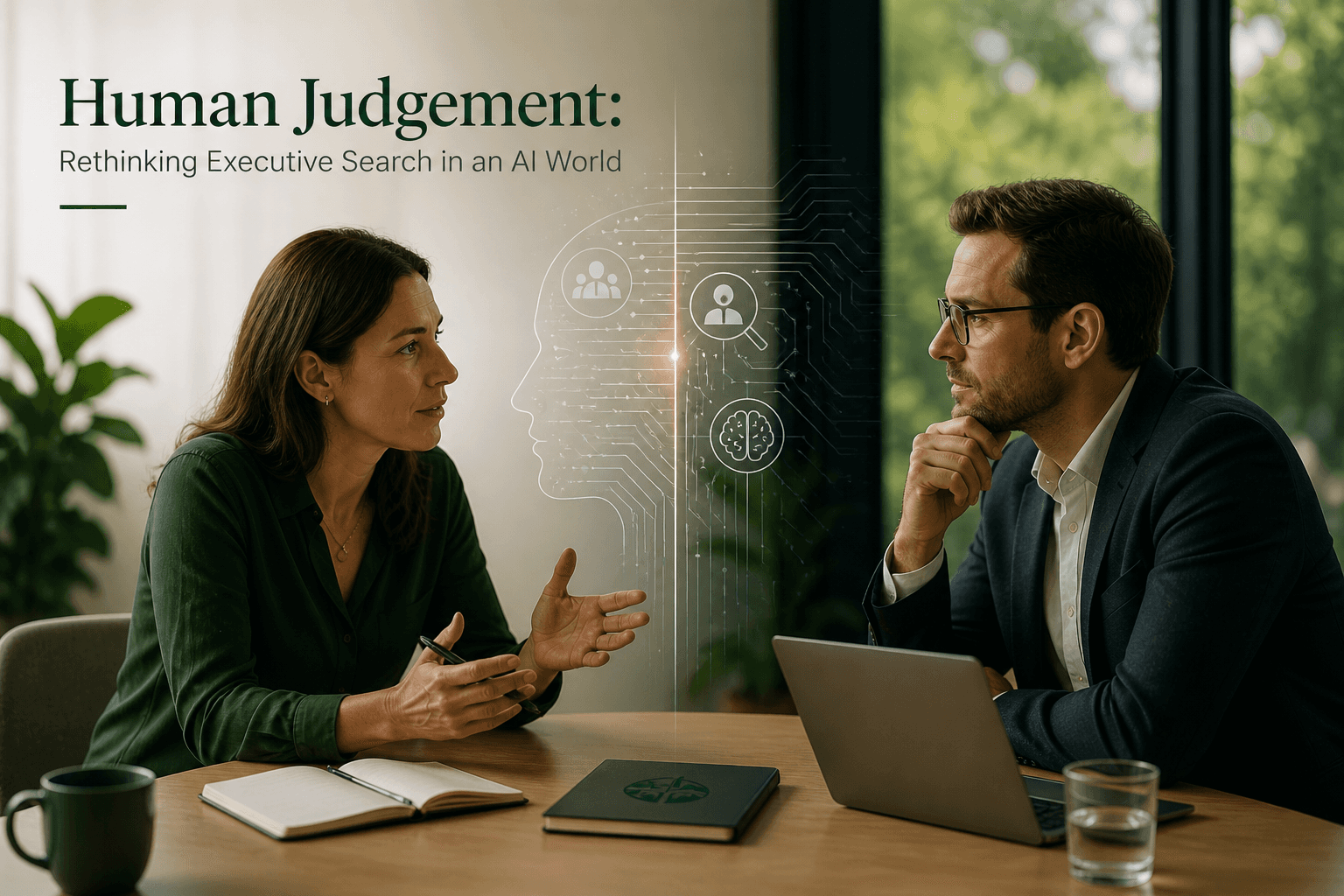
Human Judgement in an AI World: Rethinking Executive Search and Leadership
Reflections on executive search, leadership, artificial intelligence, and why human judgement, adaptability, and relationships are becoming increasingly important in a rapidly evolving business environment.
There is a quiet but significant shift happening in how organisations think about leadership.
It is no longer simply about scale, brand, or traditional career trajectories. Increasingly, organisations are focusing on adaptability, judgement, and the ability to operate effectively in environments being reshaped in real time by technology, data, and artificial intelligence.
In that context, the role of executive search is also evolving.
While large, process-driven firms continue to play an important role, there is growing recognition that in periods of rapid change, a more considered, human, and tailored approach to leadership hiring can often deliver stronger long-term outcomes.
This is where boutique firms are increasingly finding their relevance.
Leadership Roles Are Becoming More Complex
One of the most interesting developments in recent years is how leadership roles themselves are being redefined.
Job descriptions are becoming less rigid. The “perfect candidate” on paper is often not the right individual in practice. Organisations are increasingly looking beyond technical capability and traditional experience towards qualities such as adaptability, curiosity, emotional intelligence, resilience, and the ability to navigate ambiguity.
As AI automates elements of analysis, administration, and decision-support, uniquely human capabilities are becoming more valuable rather than less.
This changes the nature of executive search.
The process becomes less about matching keywords against a specification and more about understanding organisational context, leadership dynamics, culture, and long-term potential.
It also requires a different kind of conversation between advisor and client, one grounded in trust, judgement, and a deeper understanding of the organisation’s evolving needs.
Technology Improves the Process - But Not the Judgement
There is no question that AI and data-driven tools are reshaping parts of the executive search process.
Talent mapping is becoming faster. Market insights are more accessible. Patterns and connections can be identified more efficiently than ever before.
These developments are valuable and will continue to improve how search firms operate.
But technology does not replace judgement - it amplifies it.
Knowing where to look is only one part of the equation.
Understanding why an individual may succeed in a role, how they will contribute within a leadership team, and whether they will thrive within a particular organisational culture still depends heavily on human insight and experience.
Critical hiring decisions remain deeply nuanced.
That is particularly true in sectors such as sustainability, climate finance, development finance, impact investing, and mission-driven organisations, where leadership often requires balancing commercial, technical, political, and societal considerations simultaneously.
The Advantage of Being Close to the Work
One of the defining strengths of boutique executive search firms is proximity.
There is typically little separation between those developing client relationships and those delivering the search itself. Conversations tend to be more direct, feedback loops shorter, and understanding of organisational context deeper.
That proximity creates a more informed and flexible process.
Rather than operating through rigid structures alone, boutique firms are often able to adapt more quickly, think more creatively, and engage more deeply with both clients and candidates.
For candidates, this frequently results in a more thoughtful and relationship-led experience.
They are not simply being assessed against a list of requirements, but engaged in broader discussions around leadership, purpose, organisational fit, and long-term career alignment.
Organisations Are Looking for More Adaptive Leadership
Client expectations are also evolving.
Across sustainability, impact, finance, and mission-driven sectors, organisations are increasingly seeking leaders capable of operating across disciplines and stakeholder groups.
The strongest leaders are often those who can combine:
commercial understanding
strategic thinking
adaptability
relationship management
cultural awareness
systems-level thinking
These profiles rarely fit neatly into predefined categories.
As a result, many organisations are increasingly looking for search partners who can think alongside them, challenge assumptions, and bring flexibility and insight to the process rather than simply execute against a fixed brief.
Human Judgement Is Becoming More Valuable - Not Less
As AI and technology continue to evolve, the fundamentals of good decision-making remain remarkably consistent.
Clarity of purpose. Depth of understanding. Strong relationships. Sound judgement.
The tools available to organisations and search firms will continue to improve, and the pace of change will likely accelerate further.
But the need for thoughtful, informed human judgement at critical leadership moments may become even more important as complexity increases.
In that sense, being focused, adaptable, relationship-led, and close to both clients and candidates is not a limitation. Increasingly, it is a strength.
Many of these themes are already becoming more visible across sustainability, climate finance, development finance, impact investment, and mission-driven organisations globally, where leadership capability and adaptability are increasingly central to long-term organisational success.
About the Author
Noel Keogh is Founder of Green Gap Partners, a specialist executive search firm operating across sustainability and the green economy, development finance institutions, mission-driven organisations, and private sector impact.
If you are exploring leadership, talent, or organisational growth across sustainability, finance, and impact sectors, I would welcome the opportunity to connect and exchange perspectives.